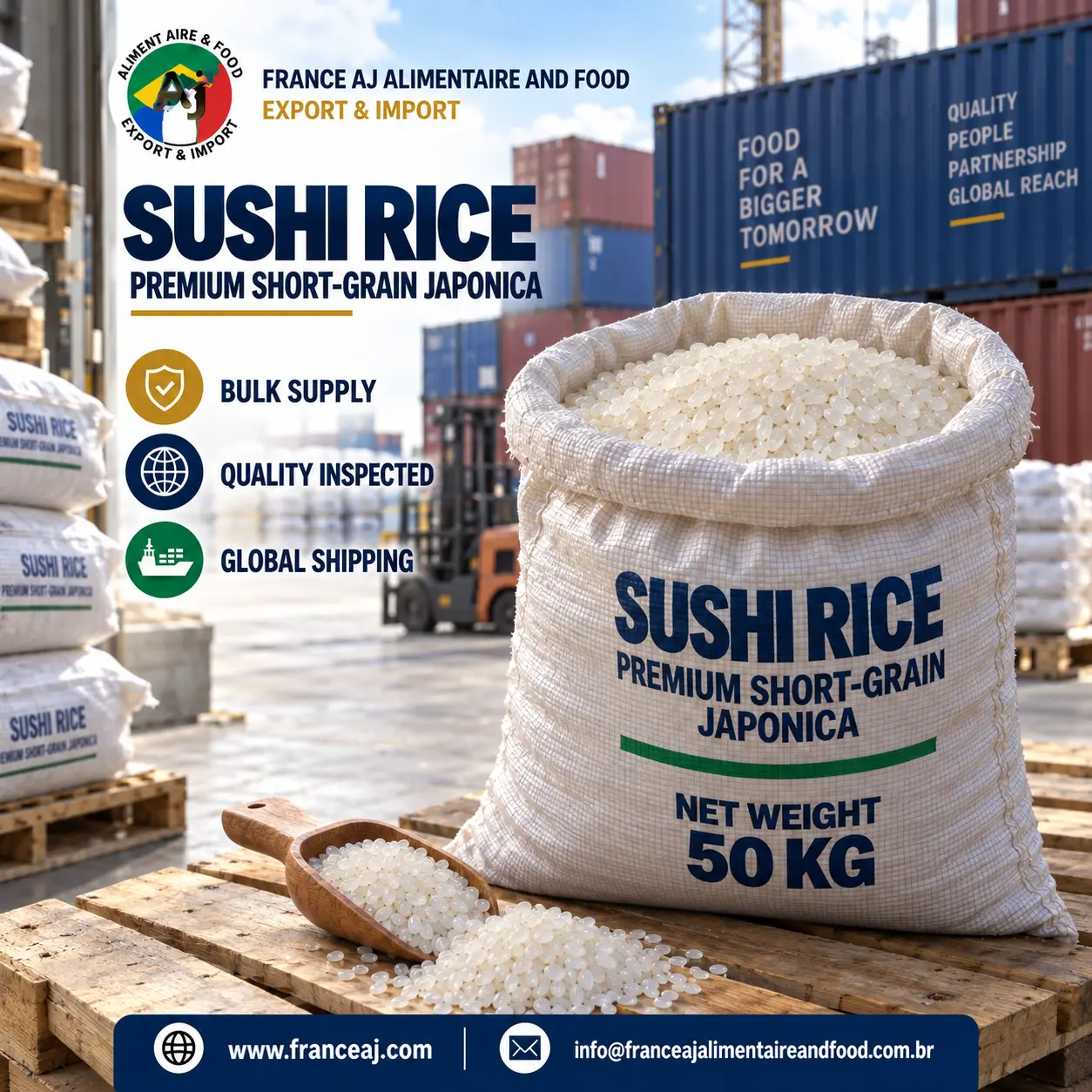
Sushi Rice (Premium Short-Grain Japonica)
Product description
France AJ Alimentaire and Food Import and Export LTDA is a sushi rice bulk supplier and sushi rice exporter sourcing short-grain japonica across Vietnam, Thailand, India, Pakistan, and Cambodia, anchored by our Vietnam japonica sushi rice program as a competitively priced Calrose alternative for foodservice buyers worldwide. Our program covers Koshihikari-type short-grain varietals with a creamy-white, glossy finish and high stickiness, milled to a Grade 1 specification, with every shipment quoted on an RFQ basis at FOB, CIF, and CFR price positions from a single container up to full 12,500 MT+ bulk vessel contracts.
Sushi Rice Specification
Our sushi rice short grain specification covers a consistent japonica profile sourced across our Vietnam, Thailand, India, Pakistan, and Cambodia origins, giving buyers one commercial reference specification to plan procurement against regardless of origin mix. The parameters below reflect standard export-grade sushi rice at Grade 1; Koshihikari-type and medium-grain (Calrose-alternative) options are quoted separately in the Trade Terms grain reference table below. Final specifications are confirmed in the seller’s official offer, certificate of analysis, and shipment inspection documents.
| Specification | Commercial Reference |
|---|---|
| Origin | Vietnam, Thailand, India, Pakistan, Cambodia (Multi-Origin Supply) |
| Product Type | Sushi Rice, Short-Grain Japonica, incl. Koshihikari-Type |
| Grade | Premium Culinary & Foodservice Grade 1 (Well-Milled, Glossy) |
| Grain Size | Short Grain (4.0 – 5.0 mm Uniform) |
| Milling Degree | Well-Milled, Polished, Glossy Finish |
| Broken Grains | 4% Max |
| Moisture Content | 14% Max |
| Aroma & Texture | Mild, Slightly Sweet / High Stickiness, Cohesive, Elastic |
| Colour | Bright, Creamy-White, Uniform Across Batches |
| Standard Packaging | Bag 25 kg / 50 kg (Bulk); 1 kg, 5 kg, 10 kg Foodservice/Private-Label Bags Available on Request |
| Vessel / Container Loading | 25 – 27 MT per Container or 12,500 MT+ Bulk Vessel |
| Payment Terms | LC / DLC / SBLC (Based on Customer Request) |
| Minimum Order Quantity (MOQ) | 1 Container up; Bulk Vessel from 12,500 MT |
| Certifications & Inspection | SGS or equivalent pre-shipment inspection available on request; produced under internationally recognized standards, including HACCP, ISO 22000, and Phytosanitary certification where applicable; non-GMO certification available on request |
Global Demand & Market Trends
Global demand for sushi rice is driven by the continued expansion of sushi QSR chains, poke bowl concepts, and Japanese restaurant networks well beyond Japan, with foodservice distributors and private-label retailers increasingly benchmarking quality against Japan-grown and Calrose (California/Australia) standards while seeking a more cost-efficient supply base. Vietnam japonica sushi rice has emerged as a competitively priced short-grain alternative that meets the stickiness and texture benchmarks foodservice buyers require, supported by parallel supply from Thailand, India, Pakistan, and Cambodia. Sushi rice prices track the broader rice commodity market and shift with harvest cycles, export policy, and freight rates across our five origins. As a sushi rice exporter across Vietnam, Thailand, India, Pakistan, and Cambodia, our trade desk tracks these cycles to help buyers who are asking where to buy sushi rice in bulk plan a sushi rice CIF price per ton position with confidence, whether sourcing for restaurant chains, private label, or foodservice distribution.
What Is Sushi Rice?
Sushi rice is short-grain japonica rice (Oryza sativa var. japonica), distinguished from long grain and jasmine varieties by a higher amylopectin starch content that produces its signature stickiness and cohesive bite once cooked and seasoned. Koshihikari-type varietals are the premium benchmark within this category, prized for a glossy finish and slightly sweet flavor, while Calrose is a medium-grain japonica varietal grown mainly in California and Australia and widely used as a foodservice standard in Western sushi restaurants. Short-grain japonica differs from medium-grain Calrose in grain length and stickiness profile, both of which are distinct from the light, separate texture of long grain and jasmine rice. This starch structure is what allows sushi rice to bind together for nigiri, maki, and temaki formation without falling apart. Buyers sourcing a non-aromatic long grain or aromatic jasmine profile instead should see our Long Grain White Rice and Jasmine Rice pages.
Industrial Applications
- Nigiri, maki, temaki, and sashimi preparation in Japanese restaurants
- Sushi QSR chains and franchise restaurant groups
- Poke bowl and fast-casual foodservice concepts
- Industrial ready-meal and onigiri manufacturing
- Retail private-label packaging for supermarket and specialty grocery channels
Why Buy Sushi Rice from France AJ Alimentaire and Food Import and Export LTDA
- Vietnam japonica credibility with multi-origin depth — our Vietnam-anchored short-grain japonica program is supported by parallel supply from Thailand, India, Pakistan, and Cambodia, giving buyers a competitively priced Calrose alternative without a single-origin dependency.
- Authentic product quality — well-milled to a glossy, uniform finish, held to a consistent Koshihikari-type stickiness and moisture specification load after load.
- Competitive pricing — buyers can buy sushi rice in bulk direct from the exporter across five origins under one contract, quoted on an RFQ basis at a current FOB CIF price to reflect market conditions.
- Flexible order quantities and MOQs — from a single-container minimum order at 25–27 MT to full bulk-vessel contracts from 12,500 MT.
- International shipping logistics — FOB, CIF, and CFR terms structured around the buyer’s destination port, with SGS or equivalent pre-shipment inspection and foodservice-ready private-label packaging.
- Strict quality control — defined broken-grain, moisture, and stickiness tolerances across every batch, with documentation aligned with HACCP and ISO 22000 standards at every shipment.
Trade Terms
| Parameter | Commercial Reference |
|---|---|
| Origin | Vietnam, Thailand, India, Pakistan, Cambodia (multi-origin, single contract) |
| Varietal | Short-Grain Japonica, incl. Koshihikari-Type |
| Moisture Content | 14% Max |
| Packaging | Bag 25 kg / 50 kg (Bulk); 1 kg, 5 kg, 10 kg Private-Label Foodservice Bags on Request |
| Minimum Order Quantity (MOQ) | 1 Container (25–27 MT) up; Bulk Vessel from 12,500 MT |
| Incoterms | FOB, CIF, or CFR destination port |
| Payment Terms | LC / DLC / SBLC (Based on Customer Request) |
| Container / Vessel Loading | 25 – 27 MT per Container or 12,500 MT+ Bulk Vessel (Supramax/Panamax) |
| Lead Time | Confirmed at Contract Stage, Origin and Destination Port Dependent |
The grain reference below sets out the short-grain and medium-grain (Calrose-alternative) specifications quoted alongside our standard Grade 1 sushi rice. Final specifications are confirmed in the seller’s official offer, certificate of analysis, and shipment inspection documents.
| Grain / Grade | Commercial Reference |
|---|---|
| Short-Grain Japonica (Koshihikari-Type) | Premium specification, high stickiness, glossy finish |
| Medium-Grain Japonica (Calrose Alternative) | Foodservice-standard specification, cost-efficient alternative |
| Grade 1 | 4% broken max, 14% moisture max, bright creamy-white colour |
Packaging & Container Loading
Standard export packaging spans 1 kg, 5 kg, and 10 kg foodservice and retail bags through to 25 kg and 50 kg bulk bags in PP, BOPP, or vacuum-sealed formats, with private-label printing available on customer request for restaurant chains and retail distributors. Bagged cargo is packed into master cartons where applicable, palletised, and stuffed to a full container load at 25–27 MT per container; loose bulk vessel loading is offered for full cargo-scale contracts, with supply from 12,500 MT upward per Supramax/Panamax vessel booking. Big-bag formats are available on request.
Ordering Process
- Buyer submits a sushi rice RFQ or ICPO on company letterhead specifying origin preference, packaging (including private-label requirements), destination port, and volume — the fastest way to request quote sushi rice exporter pricing.
- France AJ Alimentaire and Food Import and Export LTDA issues a soft offer confirming indicative terms and delivery window.
- Buyer and seller finalize and sign a sales contract covering specification, Incoterms, and payment structure.
- Buyer opens an LC, DLC, or SBLC in accordance with the agreed payment terms.
- Production, packaging, and SGS or equivalent pre-shipment inspection are completed ahead of vessel or container loading.
- Shipment proceeds with full export documentation issued for customs clearance at the destination port.
Shipment, Inspection & Documentation
Cargo loads from our Vietnam, Thailand, India, Pakistan, and Cambodia origins, with principal ports of loading at Ho Chi Minh City and Bangkok/Laem Chabang, and CIF and CFR quotations available to the buyer’s destination port on request. SGS or equivalent pre-shipment inspection and Certificate of Analysis are available on request prior to loading. Export documentation includes commercial invoice, packing list, certificate of origin, bill of lading, phytosanitary certificate, and fumigation certificate; non-GMO certificates are provided where applicable, and an organic-certified option is available on request, depending on origin and producer. Documentation requirements vary by destination market and are confirmed at contract stage.
Request Pricing
Sushi rice pricing is indicative only and moves with the world market, subject to destination port, quantity, packaging, freight, market conditions, and final seller confirmation. The reference below names principal foodservice import hubs as a planning guide only; buyers should submit an RFQ naming their own discharge port for a current quotation.
| Discharge Port | Region | Reference Note |
|---|---|---|
| Los Angeles / Long Beach | United States | Principal West Coast foodservice import hub for sushi QSR and restaurant chains; CIF/CFR quoted per RFQ, subject to market conditions |
| Rotterdam | Europe | Primary European gateway for foodservice and private-label distribution; CIF/CFR quoted per RFQ, subject to market conditions |
| Dubai / Jebel Ali | Middle East | Regional distribution hub for Gulf foodservice and retail markets; CIF/CFR quoted per RFQ, subject to market conditions |
For a current sushi rice price per ton, a FOB/CIF price position to Los Angeles/Long Beach, Rotterdam, Dubai/Jebel Ali, or any other destination port across our Vietnam, Thailand, India, Pakistan, and Cambodia origins, or a formal wholesale quotation against your RFQ, please Contact Our Sales Team to request your B2B quotation.
Request Options
Selected: Bag 25 kg · 12,500 MT
Tags
Frequently Asked Questions
What makes sushi rice different from regular long grain or jasmine rice?
Sushi rice is a short-grain japonica varietal (Oryza sativa var. japonica) with a higher amylopectin starch content than long grain or jasmine rice, which gives it the signature high stickiness and cohesive bite needed for nigiri, maki, and temaki formation. Long grain and jasmine varieties are bred for a light, separate texture, the opposite of what sushi preparation requires.
What is the difference between Koshihikari-type sushi rice and Calrose rice?
Koshihikari-type sushi rice is a premium short-grain japonica varietal prized for its glossy finish, high stickiness, and slightly sweet flavor, traditionally grown in Japan. Calrose is a medium-grain japonica varietal grown mainly in California and Australia, widely used in Western sushi restaurants as a more cost-efficient substitute. Our Vietnam-origin short-grain japonica is positioned as a competitively priced alternative to both for high-volume foodservice buyers.
What is the MOQ for bulk sushi rice export?
The MOQ starts at 1 container up (approximately 25-27 MT), with bulk vessel contracts available from 12,500 MT via Supramax/Panamax booking, so foodservice distributors and large-scale sushi chain buyers can be quoted on the same RFQ basis.
How is the sushi rice CIF price per ton quoted by port?
Pricing is quoted per metric ton on an RFQ basis and is indicative only. CIF reference prices to major foodservice import hubs such as Los Angeles/Long Beach, Rotterdam, and Dubai/Jebel Ali move with the world rice market and are subject to destination port, volume, packaging, freight, market conditions, and final seller confirmation; buyers should submit an RFQ naming their discharge port for a current quotation.
What certifications and documentation are provided for sushi rice shipments?
Shipments are supported by SGS or equivalent pre-shipment inspection and Certificate of Analysis available on request, along with phytosanitary and fumigation certificates, certificate of origin, and bill of lading; non-GMO certification is provided where applicable, and an organic-certified option is available on request. Production is carried out under internationally recognized standards, including HACCP and ISO 22000, where applicable.
What packaging options are available for sushi rice, including private label?
Sushi rice is supplied in 1 kg, 5 kg, and 10 kg foodservice and retail bags in addition to 25 kg and 50 kg bulk bags, with private-label printing available on customer request for restaurant chains and retail distributors, palletised for container loading.
How do I request a wholesale quotation for sushi rice export?
Buyers can request a wholesale quotation by submitting an RFQ with origin preference, packaging (including private-label requirements), discharge port, and volume; our trade desk responds with an indicative price per ton, Incoterms options, and lead time as a reliable sushi rice supplier for export.