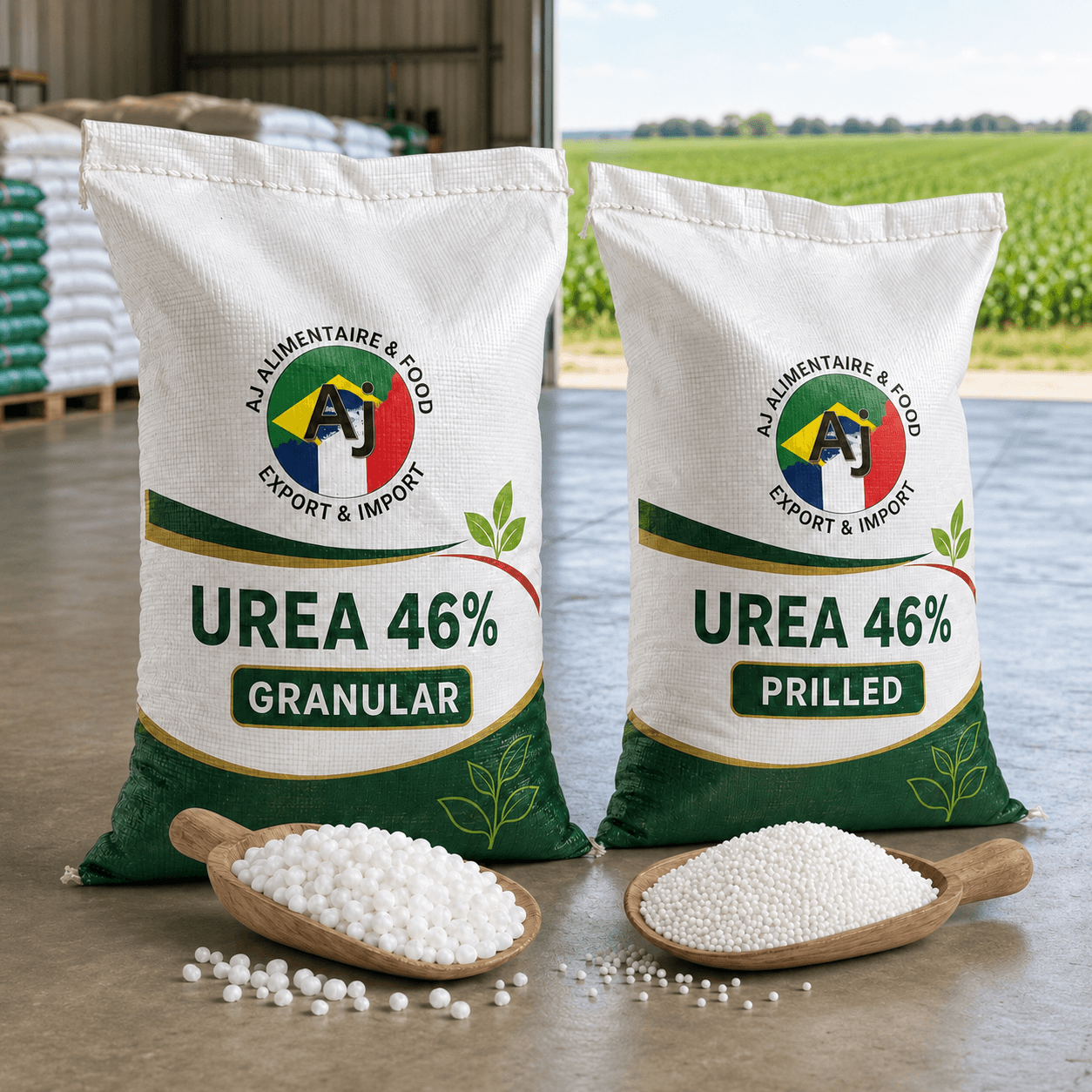
Urea 46% Granular & Prilled (N46 Nitrogen Fertilizer)
Product description
Buy Urea 46 (N46) in bulk from a B2B nitrogen-fertilizer trade desk. France AJ Alimentaire And Food Export And Import LTDA is a Urea 46 supplier and exporter of Rotterdam origin, offering granular and prilled urea 46-0-0 to importers, distributors, agricultural cooperatives and industrial buyers across Asia, Africa, Europe and the Americas. Supply is spot or contract, quoted per metric ton on RFQ under CIF or FOB terms, from container loads to full vessels.
Urea 46% Granular & Prilled (N46 Nitrogen Fertilizer) Specification
| Parameter | Specification |
|---|---|
| Origin | Netherlands (Rotterdam) |
| Product Type | Urea 46% (N46) — prilled & granular |
| Grade | Agricultural / fertilizer grade (46-0-0) |
| Nitrogen Content | 46% min (reference) |
| Biuret Content | 1.0% max (reference) |
| Moisture Content | 0.5% max (reference) |
| Prilled Particle Size | 0.85–2.80 mm |
| Granular Particle Size | 2–4 mm |
| Colour | White, free-flowing |
| Processing | Prilled / granulated |
| Packaging Options | 50kg PP/PE bags / FIBC jumbo bags (1000kg) / bulk |
| Vessel / Container Loading | Bulk vessel or 24–27 MT per container |
| Monthly Quantity | 50,000 MT – 300,000 MT |
| CIF Price Per MT | Indicative; RFQ for current market rate (subject to market and final seller confirmation) |
| Payment Terms | LC / DLC / SBLC (based on customer request) |
| Minimum Order Quantity (MOQ) | Container load to full vessel (confirmed at RFQ) |
| Inspection | SGS / Q&Q or equivalent at load port |
| Note | Commercial reference parameters; final specs confirmed in official offer, product passport analysis and inspection report |
Product Overview
Urea 46-0-0 is the most concentrated solid nitrogen fertilizer, carrying a reference minimum of 46% nitrogen (N46) for broad-acre crops, fertilizer blending and industrial uses such as AdBlue/DEF and resin production. We offer two granulometries: prilled urea (approx. 0.85–2.80 mm), which dissolves quickly and suits direct application and solution/UAN manufacturing, and granular urea (approx. 2–4 mm), whose harder, larger particles favour bulk blending, mechanical spreading and long-distance handling with less dust and caking. Both are agricultural grade, low-biuret (1.0% max reference) and white, free-flowing. Full parameters are listed in the Specifications for this product; the governing figures are those in the product passport analysis and inspection report. Rotterdam’s ARA terminal, storage and blending capacity gives importers a competitive Northwest European sourcing route with deep-water berths onto Atlantic, Mediterranean and global lanes.
Global Demand & Market Trends
Nitrogen is the highest-volume plant nutrient, and urea is its most widely traded solid form — demand is set by planting cycles across Asia, Africa and the Americas and by industrial off-take for AdBlue/DEF and technical uses. Urea pricing is closely tied to natural-gas feedstock cost and to seasonal application windows, so the CIF and FOB price per ton moves through the year rather than holding flat. Rotterdam and the wider ARA hub function as a European pricing and distribution reference, letting buyers draw prilled or granular tonnage close to Atlantic and Mediterranean routes. Indicative pricing is quoted per metric ton on RFQ, subject to discharge port, volume, packaging, freight, market conditions and final seller confirmation.
Why Source Urea 46 from France AJ Alimentaire And Food Export And Import LTDA
- Authentic product quality — agricultural-grade prilled and granular N46, low-biuret and free-flowing, with independent SGS/Q&Q (or equivalent) inspection at the load port and a product passport analysis per shipment.
- Competitive B2B pricing — CIF and FOB quotations aligned to current market rates, quoted on RFQ rather than a fixed list, for container to full-vessel volumes.
- Flexible order quantities — from 24–27 MT container loads and FIBC/50kg bagged lots to Handysize/Supramax bulk vessels on recurring monthly quotas.
- International shipping logistics — delivery to buyer-nominated discharge ports under agreed Incoterms, arranged with appointed carriers under a Charter Party Agreement.
- Strict quality control — SGS/Q&Q or equivalent inspection with a complete export document set for smooth port clearance and institutional tender compliance.
Trade Terms
| Incoterms | CIF / FOB (global ports) |
| MOQ | Container load to full vessel (confirmed at RFQ) |
| Payment terms | Irrevocable LC / DLC / SBLC MT760 / Escrow |
| Contract terms | Spot & contract supply — recurring monthly MT quotas |
| Contract types | ICPO-based — draft contract / SPA under CIF procedures 1, 2 & 3 (escrow) |
Packaging & Container Loading
- 50 kg PP/PE woven bags — palletized or loose, for distribution markets (custom marking available).
- FIBC jumbo bags (1000 kg) — for high-volume bulk handling.
- Bulk-in-vessel — Handysize/Supramax for large-tonnage contracts.
- Container loading — 24–27 MT per 20ft/40ft container.
Shipment, Inspection & Documentation
Shipments are arranged with appointed carriers under a Charter Party Agreement to your nominated discharge port. Each consignment undergoes independent SGS / Q&Q inspection (or equivalent) at the load port. Standard export documentation includes the Certificate of Origin, Product Passport Analysis, SGS/Q&Q Inspection Report and Bill of Lading, with Proof of Product (POP) issued per the agreed transaction procedure for smooth global port clearance and institutional tender compliance.
Step-by-Step Ordering & Inquiry Process
- Buyer issues an ICPO (Irrevocable Corporate Purchase Order) on company letterhead, stating product, quantity and discharge port, and selects one transaction procedure.
- Seller issues the Draft Contract / SPA; Buyer reviews, signs, seals and returns it for endorsement.
- Banking instruments are established (SBLC MT760 / DLC, or escrow) per the selected procedure.
- Seller provides Proof of Product (POP) and 2% Performance Bond, and appoints shipping under a Charter Party Agreement.
- Shipment proceeds; on arrival and SGS/Q&Q inspection, payment is released to the Seller's bank per contract terms.
CIF Transaction Procedures
Buyers select ONE (1) of the three procedures below and reproduce the selected procedure in the ICPO. All commercial, banking, inspection, shipping and commission terms remain subject to the final mutually executed contract, applicable law, bank approval and documentary verification.
CIF Transaction Procedure 1
- Buyer issues ICPO on company letterhead, including buyer banking information and valid identification.
- Seller issues Draft Contract to Buyer. Buyer reviews, signs, seals and returns it for final endorsement.
- Seller issues Commercial Invoice. Buyer issues pre-advice MT799; after confirmation by Seller's bank, Buyer opens SBLC MT760 within 7 days.
- Seller provides preliminary POP: Irrevocable Commitment to Supply, Statement of Product Availability, Certificate of Origin and Product Passport Analysis.
- Seller appoints the shipping company and signs the Charter Party Agreement for transport to Buyer's final discharge port.
- Seller issues 2% Performance Bond alongside the Full POP documents, including applicable export, refinery, transport, storage, vessel, Bill of Lading, SGS/Q&Q and shipping documents.
- Shipment commences as scheduled. Upon arrival and SGS/Q&Q or equivalent inspection, Buyer's bank releases the shipment value to Seller's bank within the agreed banking terms.
- Seller pays intermediaries according to the executed IMFPA.
CIF Transaction Procedure 2
- Buyer issues Purchase Order upon receipt and acceptance of Seller's Soft Offer.
- Seller issues Draft Sales and Purchase Agreement Contract for Buyer's review and signing.
- Seller sends partial POP to Buyer via email: (a) Statement of Availability of Product; (b) Commitment to Supply; (c) Product Passport; (d) Certificate of Origin.
- Seller appoints and signs the Charter Party Agreement with the Buyer and shipping company. Buyer and Seller pay 50/50 to the shipping company for transporting the product to Buyer's final discharge port.
- Seller SWIFTs the Full POP and 2% Performance Bond to Buyer's bank. Buyer's bank SWIFTs the Irrevocable Non-Transferable Documentary Letter of Credit to Seller's bank.
- Shipment commences as scheduled. Upon arrival at discharge port and after SGS/Q&Q or equivalent inspection, Buyer's bank releases the total shipment value to Seller's bank within 48 hours (two banking days) by MT103.
- Seller pays all intermediaries involved in the transaction as per IMFPA within 48 hours.
CIF Transaction Procedure 3 — Escrow
- Buyer confirms the Soft Offer and issues an ICPO, preferably with BCL where applicable, to Seller.
- Seller issues the Draft Contract. Buyer signs and returns it. Seller/Refinery appoints an agreed escrow/security company for both parties.
- The escrow/security company establishes a communication channel between the parties and the bilateral escrow agreement is executed.
- Seller and Buyer deposit the mutually agreed security/performance deposit for the first shipment into the escrow/security account. Deposit and refund conditions are governed by the signed escrow agreement.
- Seller proceeds with contract legalization and logistics/shipment arrangements.
- After confirmation of the agreed escrow conditions, Seller issues Full Proof of Product (POP) through the agreed secure channel / bank-to-bank process.
- Full POP may include export authorization, Statement of Product Availability, refinery commitment, transport contract, port storage agreement, tank receipts, SGS/Q&Q report, Bill of Lading/Q88 and Charter Party Agreement, as applicable.
- Shipment commences as scheduled. At the discharge port, Buyer verifies the goods and releases full payment according to the executed contract and escrow terms.
- After successful completion, Seller pays commissions according to the IMFPA and the escrow/security company releases refundable deposits according to the escrow agreement.
IMPORTANT — BUYER INSTRUCTIONS
To initiate the transaction, the Buyer must issue a formal ICPO (Irrevocable Corporate Purchase Order) on the Buyer's official company letterhead. Before submitting the ICPO, the Buyer must review the three transaction procedures presented in this offer and select ONE (1) procedure that best corresponds to the Buyer's preferred transaction and banking structure.
The selected procedure must be clearly stated and reproduced in the ICPO, together with the requested product, quantity, destination/discharge port, company details, authorized signatory information and applicable banking details.
The completed and duly signed ICPO must be sent by email to: info@franceajalimentaireandfood.com.br
After receipt and preliminary review of the ICPO, the Buyer will receive an official response by email directly from the refinery or its authorized commercial representative. The Buyer will then continue the transaction directly with the refinery in accordance with the selected procedure, subject to refinery acceptance, compliance review, documentary verification and final contractual approval.
Request Options
Selected: Bag 25 kg · 50,000 MT
Documents
Tags
Frequently Asked Questions
What is Urea 46 (46-0-0) and what does N46 mean?
Urea 46 is the nitrogen fertilizer grade 46-0-0, meaning 46% nitrogen and no phosphorus or potassium. N46 refers to that 46% minimum nitrogen content. It is the most concentrated solid nitrogen fertilizer, used for broad-acre crops, fertilizer blending and industrial applications.
What is the difference between granular and prilled urea?
Both are 46% nitrogen urea. Prilled urea has smaller particles (approx. 0.85 to 2.80 mm) and dissolves quickly, suiting direct application and solution/UAN manufacturing. Granular urea has larger, harder particles (approx. 2 to 4 mm) with greater crush strength, better suited to bulk blending, mechanical spreading and long-distance handling with less dust and caking.
What nitrogen and biuret specification applies to your Rotterdam urea?
It is agricultural/fertilizer grade 46-0-0 with a reference minimum of 46% nitrogen, biuret controlled to 1.0% max and moisture to 0.5% max, white and free-flowing. These are commercial reference parameters; the actual figures are confirmed on the product passport analysis and inspection report for each shipment.
What packaging and container loading options are available for bulk orders?
We offer 50kg PP/PE woven bags, FIBC jumbo bags (1000kg) and bulk-in-vessel loading. Containerised shipments typically load 24 to 27 MT per unit, while larger contracts move via bulk vessel (Handysize/Supramax). Custom bag marking is available for distribution markets.
What is the MOQ and which Incoterms/ports do you supply under?
MOQ ranges from a container load to a full vessel, confirmed at RFQ. We ship under CIF and FOB terms to buyer-nominated discharge ports worldwide, including CIF ASWP and major hubs, with recurring monthly MT quotas for contract buyers across Asia, Africa, Europe and the Americas.
How do I import urea 46 from Rotterdam and what documentation is provided?
The process begins with a buyer ICPO, followed by a draft contract, agreed banking instruments (LC/SBLC or escrow), Proof of Product (POP) and shipment. Each shipment includes SGS/Q&Q inspection reports, certificate of origin, product passport analysis and bill of lading for smooth customs clearance. Contact our sales team for a soft offer and current CIF/FOB pricing.