Canned Skipjack Tuna Wholesale from Vietnam: B2B Buyer & RFQ Guide
A B2B buyer's guide to canned skipjack tuna wholesale from Vietnam: chunk, solid and shredded pack styles, 307/108 and 307/111 cans from 140g to 185g net weight, net vs drained weight, 48-can cartons with English and Arabic labels, how FOB and CIF per-carton pricing works, MOQ and container loading, LC payment, export documents, and what to include in an RFQ.
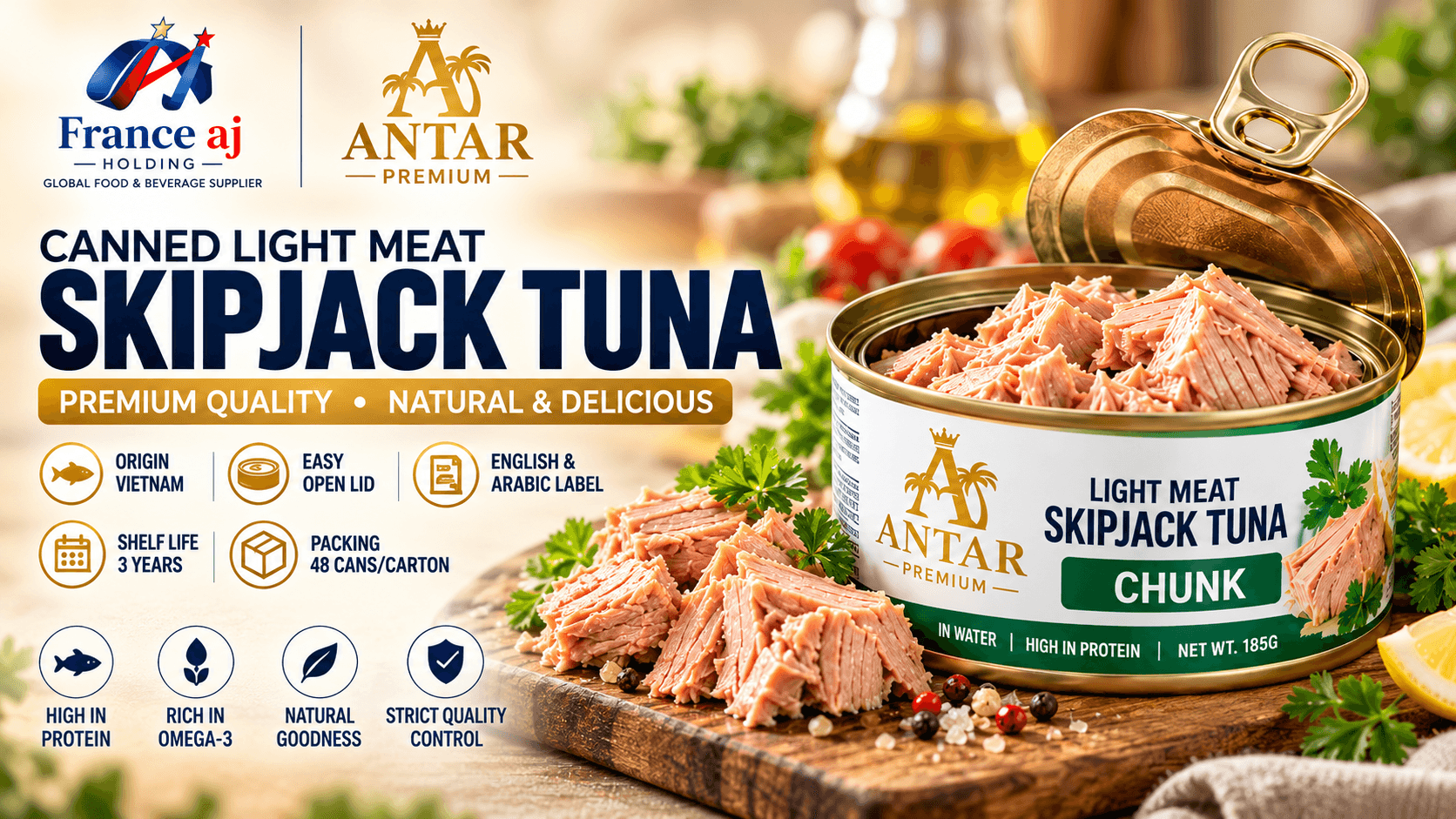
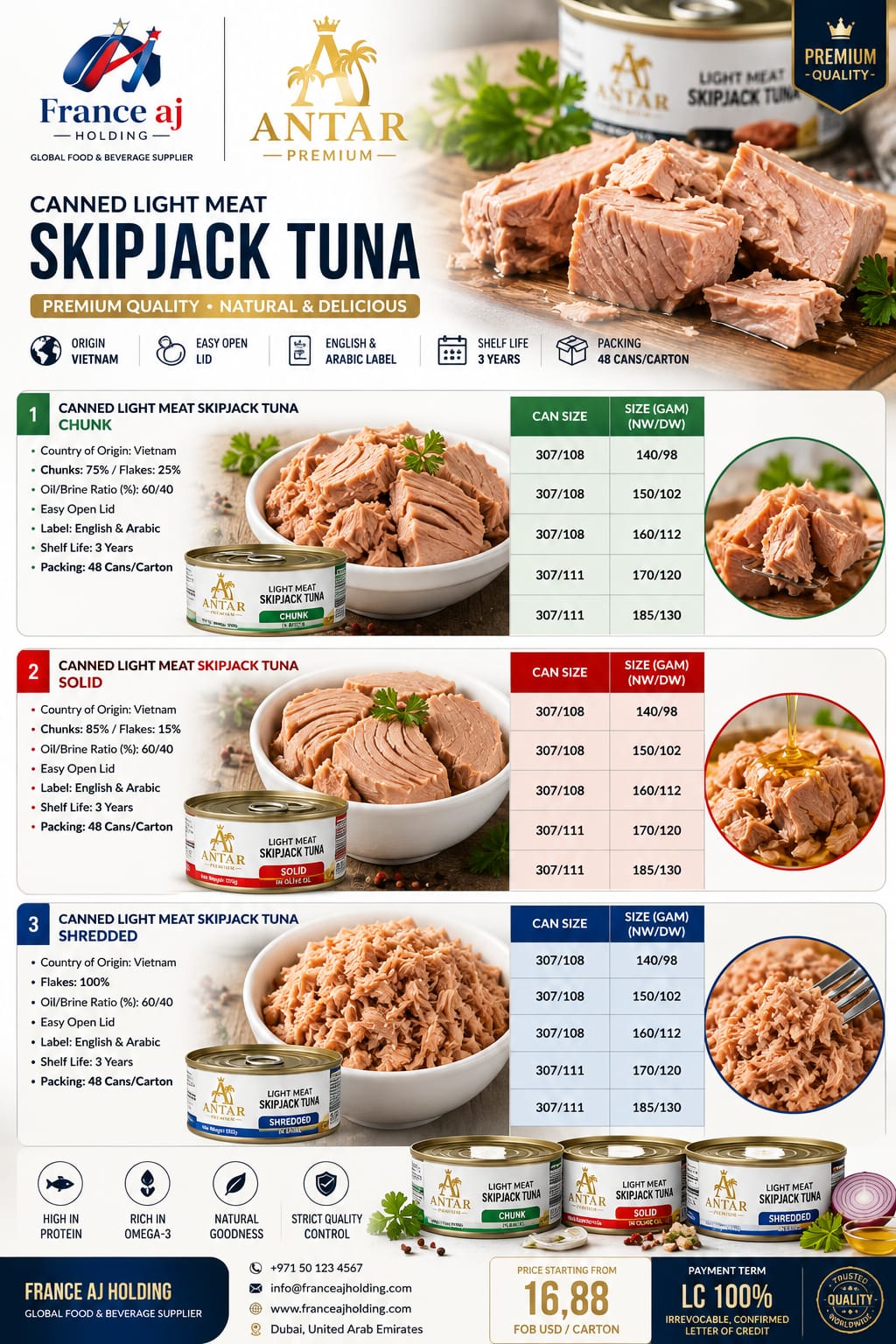
France AJ supplies canned skipjack tuna wholesale from Vietnam to importers, wholesale distributors, supermarket procurement teams, foodservice companies and trading houses. The range covered in this guide is canned light meat skipjack tuna under the ANTAR Premium label, offered in three pack styles — chunk, solid and shredded — in 307/108 and 307/111 easy-open cans from 140g to 185g net weight, packed 48 cans per carton.
Our trade desk quotes canned tuna price per carton at FOB Vietnam or CIF to the buyer’s destination port, on an RFQ basis. Any figure shared is indicative only: it moves with the world market and is subject to destination port, quantity, packaging, freight, market conditions and final seller confirmation.
This guide sets out the reference specifications from the supplier’s product sheet, explains how the three styles and five can sizes compare, and lists what a Vietnam canned seafood supplier needs from you to return a complete quotation rather than a preliminary indication.
Request a canned skipjack tuna quotation
Canned Light Meat Skipjack Tuna: Product Overview
Skipjack tuna (Katsuwonus pelamis) is the species most widely used for light meat canned tuna. “White meat” canned tuna is albacore; skipjack gives a light pink-to-tan colour, a mild flavour and a firm, flaking texture. It is the everyday canned tuna of supermarket shelves, catering kitchens and ready-meal production.
Canned tuna is shelf-stable at ambient temperature. It ships in dry containers and is stored in ordinary warehouses, without the reefer equipment, cold-store capacity and power costs that frozen seafood requires — often the deciding logistics advantage for distributors in hot-climate markets.
The values below are commercial reference parameters taken from the supplier’s product sheet; final specifications are confirmed in the seller’s official offer, Certificate of Analysis and shipment inspection documents.
| Specification | Reference value |
|---|---|
| Product | Canned light meat skipjack tuna |
| Brand shown | ANTAR Premium (brand availability confirmed per market) |
| Origin | Vietnam |
| Pack styles | Chunk • Solid • Shredded |
| Can sizes | 307/108 (140g, 150g, 160g NW) • 307/111 (170g, 185g NW) |
| Lid | Easy-open |
| Label | English & Arabic |
| Shelf life | 3 years (per supplier sheet) |
| Packing | 48 cans per carton |
| Pricing | FOB / CIF per carton, quoted on RFQ |
Why Buyers Source Canned Tuna from Vietnam
Vietnam has built a substantial tuna processing sector around its central-coast fishing grounds, and canned tuna has become one of its fastest-growing seafood export lines. According to the Vietnam Association of Seafood Exporters and Producers (VASEP), as reported by Atuna, Vietnam’s canned tuna exports reached a record of around USD 299 million in the second half of 2024, with the US, Israel, Germany, Lebanon and Egypt among the largest destinations.
For B2B buyers, the practical reasons to work with a canned tuna supplier in Vietnam are:
- Established export formats – 48-can cartons in the 140g–185g range are standard export packs, which makes comparison with other origins straightforward.
- Market-ready labelling – the ANTAR Premium sheet shows English and Arabic labels, a combination widely used in Middle East and North African retail.
- Origin diversification – buyers already sourcing from Thailand or other Asian origins can add Vietnam as a second source under one trading relationship.
- Shelf-stable logistics – dry-container shipping and a long reference shelf life suit distributors serving long inland supply chains.
Product is sourced from producers operating under internationally recognized standards, including ISO 9001, HACCP and GMP where applicable. SGS or equivalent pre-shipment inspection and a Certificate of Analysis are available on request; applicable certificates are provided depending on product, origin, producer and shipment.
Chunk vs Solid vs Shredded Skipjack Tuna
The three pack styles differ in the share of whole chunks to flakes in each can. That ratio drives presentation, end use and price positioning, so it should be stated explicitly in every RFQ.
| Pack Style | Chunk / Flake Ratio (reference) | Texture | Typical Buyer Use |
|---|---|---|---|
| Chunk | 75% chunks / 25% flakes | Medium pieces with some flakes | Mainstream retail, salads, sandwiches, ready meals |
| Solid | 85% chunks / 15% flakes | Largest intact pieces | Premium retail lines, foodservice plating, pasta and salad toppings |
| Shredded | 100% flakes | Fine, uniform flakes | Spreads, fillings, value retail, institutional catering |
- Chunk is the volume line for mainstream supermarket shelves and general foodservice.
- Solid carries the highest chunk content and suits premium shelf positioning where the fish is the centre of the dish.
- Shredded is the value line for spreads, fillings, school and institutional catering.
Packing medium (oil, brine or a combination) is confirmed in the seller’s official offer. Buyers should state their preferred medium in the RFQ, as it affects both drained weight presentation and price.
Can Sizes, Net Weight and Drained Weight
Net weight (NW) is the full contents of the can, including the packing liquid. Drained weight (DW) is the tuna that remains once the liquid is removed. Two cartons at the same price can carry different quantities of fish, so experienced buyers compare canned tuna net weight and drained weight rather than net weight alone.
The can code gives dimensions in inches and sixteenths of an inch. 307/108 is 3 7/16″ in diameter (about 87 mm) by 1 8/16″ high (about 38 mm). 307/111 has the same diameter at 1 11/16″ high (about 43 mm).
| Can Code | Net Weight (NW) | Drained Weight (DW) | DW as % of NW | Styles |
|---|---|---|---|---|
| 307/108 | 140g | 98g | 70% | Chunk • Solid • Shredded |
| 307/108 | 150g | 102g | 68% | Chunk • Solid • Shredded |
| 307/108 | 160g | 112g | 70% | Chunk • Solid • Shredded |
| 307/111 | 170g | 120g | 71% | Chunk • Solid • Shredded |
| 307/111 | 185g | 130g | 70% | Chunk • Solid • Shredded |
Drained weight runs at roughly 68–71% of net weight across the range. The 185g / 130g and 170g / 120g sizes are the most common formats for family-size retail, while 140g–160g cans suit single-portion and value shelves. All five sizes are listed for chunk, solid and shredded styles on the supplier sheet; availability of a specific style-and-size combination is confirmed at quotation.
Packaging: 48 Cans Per Carton
All five sizes are packed 48 cans per carton. For the 185g can that is 8.88 kg net and 6.24 kg drained per carton; for the 140g can, 6.72 kg net and 4.70 kg drained. The carton is the pricing unit for FOB and CIF quotations, so per-carton comparisons only hold when can size, style and drained weight are matched.
- Easy-open lid on all sizes
- English and Arabic label per supplier sheet; wording, importer details and market-specific requirements confirmed for your destination
- Carton dimensions, gross weight and carton marking confirmed in the seller’s official offer
- Private label or another label language: state the requirement in the RFQ; availability is subject to producer confirmation
Wholesale Canned Tuna FOB and CIF Pricing
There is no fixed list price for wholesale canned tuna. France AJ quotes per carton at FOB (Vietnamese port of loading) or CIF (the buyer’s named destination port). Under FOB the buyer arranges ocean freight and insurance; under CIF those costs are included to the destination port.
The main factors that move a canned tuna FOB price per carton are:
- Raw material – the world price of skipjack, which moves with catch levels and cannery demand
- Pack style – solid generally prices above chunk, and chunk above shredded
- Can size and drained weight
- Packing medium and label requirements
- Tinplate and packaging costs
- Quantity and contract length – single shipment versus recurring monthly supply
- Freight and destination – for CIF, the trade lane and discharge port
Promotional figures shown on product sheets are reference points only and are not an offer. Every quotation is indicative, moves with the world market, and is subject to destination port, quantity, packaging, freight, market conditions and final seller confirmation.
Minimum Order Quantity and Container Loading
The minimum order quantity for canned skipjack tuna is set at quotation stage and depends on pack style, can size and production scheduling at the cannery. Export canned tuna is commonly quoted by the full container, and buyers can ask whether a mixed container of styles or sizes is possible for their order.
The number of cartons per 20ft or 40ft container depends on can size, carton dimensions, palletisation and destination payload limits. Our trade desk confirms carton count per container, net and gross weight and container type in the seller’s official offer. Buyers planning a bulk canned tuna programme should state whether the requirement is a single shipment or monthly canned tuna supply, so production slots and container bookings can be planned.
Shipping and Export Documentation
Canned tuna ships in dry containers from Vietnamese ports on FOB or CIF terms. Lead time from contract and payment instrument to loading depends on production scheduling and label preparation, and is fixed in the sales contract together with the shipment schedule.
A typical canned tuna export document set includes:
- Commercial invoice
- Packing list
- Bill of Lading
- Certificate of origin
- Health certificate issued by the competent authority, where required by the destination
- Certificate of Analysis, available on request
- SGS or equivalent pre-shipment inspection report, available on request
- Halal certificate, where available from the producer and required by the destination
Requirements vary by destination country and are confirmed at contract stage. France AJ Alimentaire and Food Import and Export LTDA confirms in writing which documents apply to each shipment. Importers should also check their own market’s rules for canned seafood — product registration, label language, importer licensing and any catch-documentation requirements — before contracting.
Payment Terms and International Trade Procedures
Payment is by irrevocable Letter of Credit (LC), with the instrument type, confirmation requirements and documentary conditions set in the final sales contract. Buyers should check with their bank in advance that it can issue an LC on these terms.
Orders follow France AJ’s standard trade sequence:
- RFQ – the buyer submits requirements (see the next section).
- Soft offer – our trade desk returns a quotation per carton at FOB or CIF.
- ICPO – the buyer issues an Irrevocable Corporate Purchase Order on company letterhead confirming the agreed terms.
- Sales contract – specification, quantity, price basis, Incoterm, payment and shipment schedule.
- Payment instrument – the buyer’s bank opens the LC per the contract.
- Production and inspection – SGS or equivalent pre-shipment inspection on request.
- Shipment and documents – loading and presentation of the export document set.
How to Request a Wholesale Quotation
A complete canned tuna RFQ lets our trade desk return a full soft offer for review instead of a preliminary price indication. Please include:
- Pack style – chunk, solid or shredded, or a mix per container
- Can size – 307/108 or 307/111, with the NW/DW required
- Packing medium – oil, brine or as per your market
- Quantity – cartons or containers per shipment, and whether the order repeats monthly
- Label – language, brand (ANTAR Premium or private label) and market-specific wording
- Destination – exact discharge port and country
- Incoterm – FOB or CIF
- Payment – confirmation that your bank can issue an irrevocable LC
- Company details – registered name, address and import licence where required
Buyers sourcing other Vietnam-origin food commodities can also review our Vietnam cashew kernel grades and pricing guide, or browse the full France AJ product catalogue.
Frequently asked questions
What is canned light meat skipjack tuna?
It is canned tuna made from skipjack (Katsuwonus pelamis), the species most widely used for light meat tuna. It has a light pink-to-tan colour and a mild flavour, and France AJ supplies it from Vietnam in chunk, solid and shredded styles.
What is the difference between chunk, solid and shredded tuna?
As commercial reference parameters, chunk style is 75% chunks and 25% flakes, solid style is 85% chunks and 15% flakes, and shredded style is 100% flakes. Final ratios are confirmed in the seller's official offer and shipment inspection documents.
What do NW and DW mean on canned tuna?
NW is the net weight of the full can contents, including the packing liquid. DW is the drained weight of the tuna after the liquid is removed. For example, a 307/111 can at 185g NW carries 130g DW as a commercial reference, so buyers should compare offers on drained weight.
Which can sizes and packaging are available?
Reference sizes are 307/108 cans at 140g, 150g and 160g net weight and 307/111 cans at 170g and 185g net weight, all with easy-open lids and packed 48 cans per carton. Availability of each style and size is confirmed at quotation stage.
How is wholesale canned skipjack tuna priced?
Pricing is quoted per carton on an RFQ basis at FOB Vietnam or CIF to the buyer's destination port. Any price shared is indicative only, moves with the world market, and is subject to destination port, quantity, packaging, freight, market conditions and final seller confirmation.
What is the minimum order quantity and how many cartons fit in a container?
The minimum order quantity and the carton count per container are confirmed by our trade desk at quotation stage, because both depend on pack style, can size, carton dimensions and destination payload limits. Buyers should state whether they need a single shipment or monthly supply.
What payment terms and export documents apply?
Payment is by irrevocable Letter of Credit on the terms set in the final sales contract. The typical document set includes a commercial invoice, packing list, Bill of Lading and certificate of origin, with health certificate, Certificate of Analysis and SGS or equivalent inspection where required and available. Requirements are confirmed at contract stage.
What is the shelf life and label language?
The supplier's product sheet states a shelf life of 3 years and English and Arabic labels. Buyers should confirm label wording and any market-specific labelling requirements for their destination in the RFQ.
Request a Quotation: Contact France AJ for Bulk Canned Tuna Supply
France AJ supplies canned skipjack tuna wholesale from Vietnam to B2B buyers across the Middle East, Africa, Asia and Europe. Send your RFQ with the details above and our trade desk will reply with a market-based soft offer.
- Product: Canned Light Meat Skipjack Tuna (ANTAR Premium)
- Origin: Vietnam
- Styles: Chunk • Solid • Shredded
- Can sizes: 307/108 (140g–160g NW) • 307/111 (170g–185g NW)
- Packaging: 48 cans per carton, easy-open lid
- Minimum order: Confirmed at quotation
- Pricing: Indicative FOB/CIF per carton, quoted per RFQ
- Payment: Irrevocable Letter of Credit, per the sales contract
- Emailinfo@franceajalimentaireandfood.com.br
- Tel / WhatsApp(+55) 31 91014-3894
- Webwww.franceaj.com
- OfficeSão Paulo, Brazil
France AJ — From Brazil to the World. Quality • Reliability • Integrity.